

New Publication on International Journal of Hydrogen Energy
The paper "Hybrid superconducting energy pipelines: key cost thresholds and system implications for Italy", authored by Matilde Cais, Matteo Nicoli, Giovanni Mangiulli and Laura Savoldi has been published on International Journal of Hydrogen Energy.
Abstract
Hydrogen is a key vector for energy-sector decarbonization by 2050, yet large-scale transmission options are limited. This study evaluates the cost-competitiveness of a hybrid SuperConducting Energy Pipeline (SCEP) simultaneously delivering electricity and liquid hydrogen, firstly introduced in a scenario-based capacity expansion analysis within a multi-vector energy system model. A multi-region optimization model of the Italian power and hydrogen sectors is developed using the open-source TEMOA-Italy framework. Multiple scenarios to 2050 explore emission targets, hydrogen generation options, and techno-economic parameters to assess SCEP deployment relative to conventional transmission lines. Results show the specific SCEP configuration becomes cost-effective below a capital cost around 610 M€/km/MW, or 1430 M€/km/MW if conventional line costs double. When adopted, SCEP promotes centralized hydrogen generation in high-renewable regions, increasing 2050 electrolysis output in Sardegna by ∼10 times. Findings highlight SCEP's potential role in the Italian energy transition under specific economic and policy conditions.
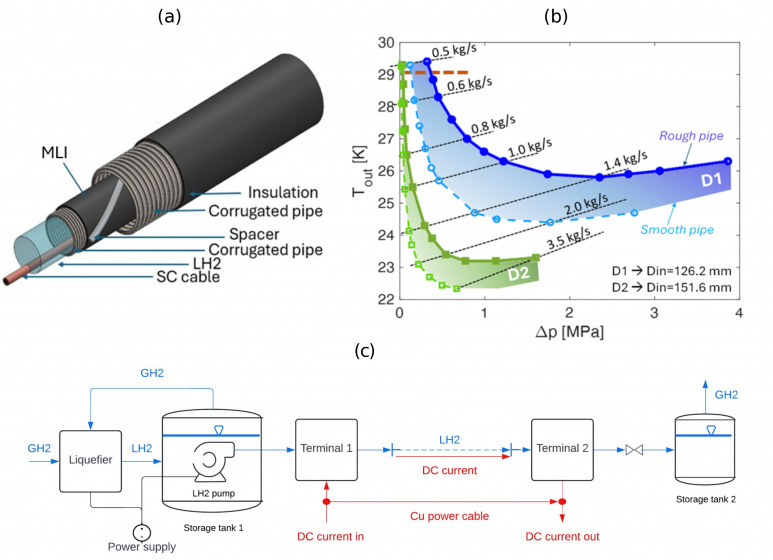
Figure 2. Tentative layout of the SCEP considered in the present analysis (as designed in [28]), with a sketch of the auxiliaries. (a) Cable cross section, highlighting the superconducting (SC) cable, the inner corrugate pipe, confining the LH2 and surrounded by Multi-Layer Insulation (MLI), the low-conductivity spacer, the outer corrugate pipe constituting the outer cryostat, surrounded by the thermal insulation. (b) Operation range for the LH2 pipeline in terms of outlet temperature and pressure drop along the duct. D2 is the cryostat corrugated pipe with Din = 126.2 mm, D1 the one with Din = 151.6 mm. (c) Layout of the hybrid pipeline, with the auxiliaries for the supply and management of the cryogen.
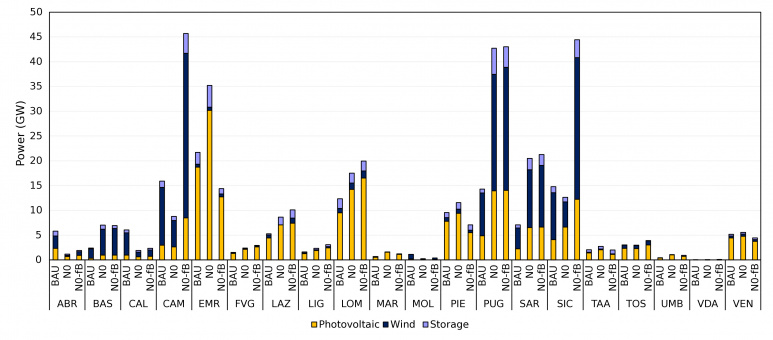
Figure 6. Regional distribution of photovoltaic, wind and storage capacity in 2050 in scenarios BAU (a), N0 (b) and N0-fB (c).
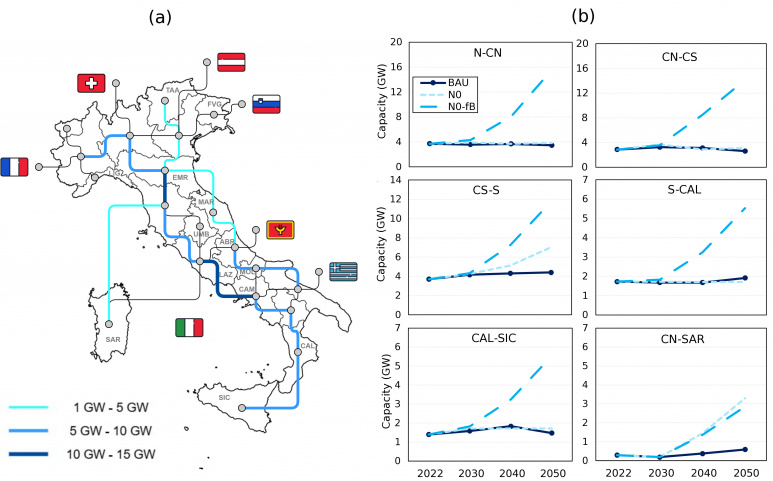
Figure 8. Regional electricity transmission lines in 2050 for the N0-fB scenario (a) and electric transmission capacity between bidding zones for BAU, N0 and N0-fB scenarios from 2030 to 2050 compared to Terna’s values for 2022 (b).
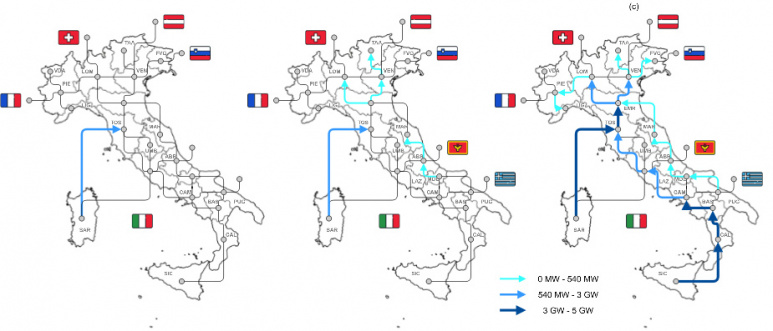
Figure 10. Installed SCEP capacity and directions of energy flows through SCEP in 2050 for scenarios SCEP30_TR100 (a), SCEP20_TR100 (b) and SCEP10_TR100 (c).